
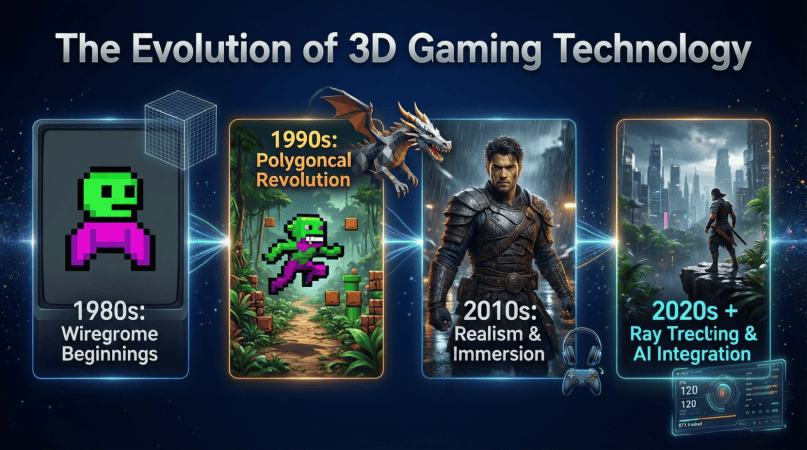
3D gaming technology has transformed the way we interact with virtual worlds, providing immersive experiences that were once the realm of science fiction. From simple 2D sprites to expansive, photorealistic environments, the journey of 3D gaming is a testament to human creativity and technological advancement.
1. The Beginnings of 3D Gaming
The inception of 3D gaming can be traced back to the early 1970s with the introduction of vector graphics. Games like Computer Space (1971) and Battlezone (1980) laid the groundwork for what would evolve into a multi-billion dollar industry.
These early games utilized basic 3D rendering techniques, primarily focusing on wireframe graphics. However, the lack of powerful processors and graphics capabilities limited their potential.
Key Milestones:
- 1971: Computer Space – The first arcade game with a 3D perspective.
- 1980: Battlezone – One of the first games to use 3D vector graphics.
- 1982: Zaxxon – Introduced isometric projection, adding depth to gameplay.
2. The Rise of 3D Graphics in the 1990s
The 1990s marked a significant turning point for 3D gaming technology. The release of Wolfenstein 3D in 1992 popularized the first-person shooter genre and showcased the potential of 3D environments. This game utilized ray casting to create a pseudo-3D effect, allowing players to navigate through a three-dimensional space.
Following Wolfenstein, Doom (1993) further pushed the boundaries with its advanced graphics and multiplayer capabilities. These games laid the foundation for future developments in 3D gaming.
Advancements in 3D Graphics:
| Game | Year | Significant Feature |
|---|---|---|
| Wolfenstein 3D | 1992 | Pseudo-3D environments using ray casting. |
| Doom | 1993 | Innovative graphics and multiplayer mode. |
| Quake | 1996 | True 3D graphics and a fully immersive environment. |
3. The Advent of 3D Accelerators and Console Gaming
The late 1990s saw the introduction of 3D graphics accelerators, which drastically improved the quality and performance of 3D games. Companies like 3dfx and NVIDIA led the charge, making it possible for home computers to render complex 3D environments.
Consoles like the PlayStation (1994) and Nintendo 64 (1996) brought 3D gaming to the mainstream. Games such as Final Fantasy VII and Super Mario 64 showcased the capabilities of 3D graphics in storytelling and gameplay.
Impact of 3D Accelerators:
- Improved texture mapping and lighting effects.
- Higher frame rates and smoother gameplay.
- Increased complexity in game worlds and character models.
4. The Modern Era: Realism and Virtual Reality
As technology advanced, so did the expectations of gamers. The 2000s and 2010s introduced high-definition graphics, real-time lighting, and physics engines that made 3D environments more realistic than ever before. Games like Half-Life 2 (2004) and Grand Theft Auto V (2013) set new standards for visual fidelity and immersive gameplay.
Enter virtual reality (VR), which has taken 3D gaming to a new level. With devices like the Oculus Rift and HTC Vive, players can experience games in a fully immersive 3D space. This technology has opened up new possibilities for gameplay mechanics and storytelling.
Modern 3D Gaming Technologies:
| Technology | Year Introduced | Significance |
|---|---|---|
| High-Definition Graphics | 2000s | Increased realism and detail in game worlds. |
| Physics Engines | 2000s | Realistic interactions and movements in games. |
| Virtual Reality | 2010s | Immersive experiences that redefine gameplay. |
5. The Future of 3D Gaming Technology
Looking ahead, the future of 3D gaming is bright. Technologies like ray tracing, AI-driven graphics, and cloud gaming are set to revolutionize the industry further. Ray tracing, for instance, allows for incredibly realistic lighting and reflections, enhancing the visual experience.
Moreover, the convergence of gaming with augmented reality (AR) and AI could lead to entirely new forms of interactive experiences. As hardware continues to advance, we can expect more seamless integration between the virtual and real worlds.
Anticipated Trends:
- Increased realism through ray tracing.
- AI-driven procedural generation for richer game worlds.
- Expansion of cross-platform and cloud gaming services.
Conclusion
The evolution of 3D gaming technology has been a remarkable journey, characterized by rapid advancements and innovations. From the early days of vector graphics to the immersive experiences of today, the industry has continuously pushed the boundaries of what is possible.
As we look to the future, the potential for growth and development in 3D gaming remains immense. For those eager to experience the pinnacle of what modern gaming has to offer, check out our article on Premium 3D Games: The Ultimate Gaming Experience.

AA Products High Back Ergonomic Gaming Chair
AA Products Gaming Chair Ergonomic High Back Computer Racing Chair Adjustable Office Chair with Footrest, Lumbar Support Swivel Chair - BlackOrange

Beats-Studio Pro Cancelling Headphones
Beats Studio Pro - Wireless Bluetooth Noise Cancelling Headphones with USB-C Charging Cable (20 cm) - Jet Black

Apple AirTag 4 Pack
Brand Apple Are Batteries Included Yes Number of Batteries 4 CR2032 batteries required. (included) Product Dimensions 1.26\"L x 1.26\"W x 0.31\"Th Compatible Devices airtag

Canon PG-275
Canon PG-275 / CL-276 Genuine Ink Value Pack (2 Cartridges), Compatible with TS3520/3522/4722/3720/3722, TR4720