
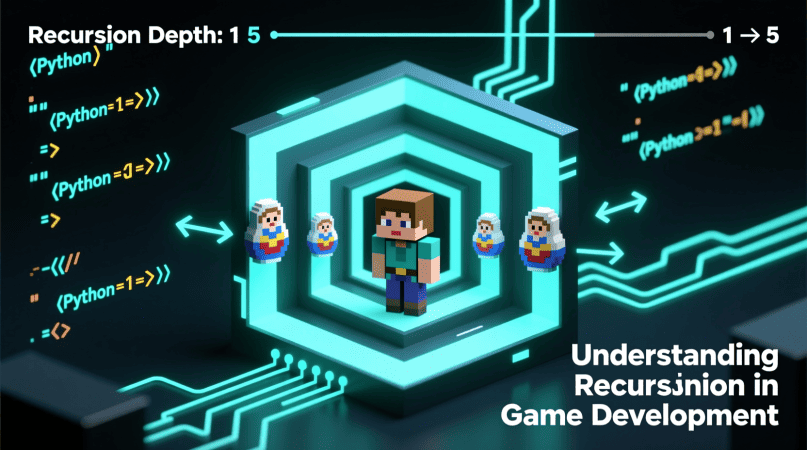
Recursion is a powerful concept in programming that has significant applications in game development. Whether you’re creating complex algorithms for pathfinding, implementing game AI, or managing game states, understanding recursion can enhance your programming toolkit. In this article, we’ll explore the ins and outs of recursion, provide real-life examples, and guide you through its application in game development.
What is Recursion?
At its core, recursion is a method where a function calls itself to solve a problem. This self-referential process breaks down a problem into smaller, more manageable parts, making it easier to solve complex issues. Think of it like peeling an onion; you keep removing layers until you reach the core.
How Recursion Works
For recursion to work effectively, two main components are necessary:
- Base Case: This is the condition that stops the recursion. Without it, the function would call itself indefinitely, leading to a stack overflow.
- Recursive Case: This is where the function calls itself with a modified argument, gradually moving towards the base case.
A Simple Example: Factorials
Let’s look at a classic example of recursion: calculating the factorial of a number.
function factorial(n) {
    if (n === 0) {
        return 1; // Base case
    }
    return n * factorial(n - 1); // Recursive case
}
In this example, if we call factorial(5), the function will compute:
5 * factorial(4)4 * factorial(3)3 * factorial(2)2 * factorial(1)1 * factorial(0)
Finally, it returns 120, as 5! = 5 * 4 * 3 * 2 * 1.
Recursion in Game Development
Recursion can be particularly useful in various aspects of game development, from AI to procedural generation. Here are a few areas where recursion shines:
1. Pathfinding Algorithms
Pathfinding is crucial in AI for games. Algorithms like A* can utilize recursion to explore various paths and determine the shortest route from point A to point B. For instance, if an NPC needs to navigate a maze, recursion allows it to explore all possible routes until it finds the exit.
2. Game State Management
In complex games, managing states can become challenging. Recursion helps to manage states effectively by allowing the game to revert back to previous states when needed. This is particularly useful in games with multiple levels or stages.
3. Procedural Generation
Many games, especially in the indie scene, utilize procedural generation to create vast worlds. Recursion plays a significant role in generating terrain, dungeons, or even entire galaxies by subdividing larger areas into smaller sections and applying generation rules repeatedly.
Step-by-Step: Implementing Recursion in a Game
Let’s walk through a simple implementation of recursion in a game context. We’ll create a basic maze generator using recursion.
Step 1: Set Up the Maze Structure
let maze = [];
const width = 10;
const height = 10;

for (let i = 0; i < height; i++) {
    maze[i] = [];
    for (let j = 0; j < width; j++) {
        maze[i][j] = 1; // Fill the maze with walls
    }
}
Step 2: Create the Recursive Function
This function will carve out paths in the maze by modifying the wall structure.
function carvePath(x, y) {
    // Base Case: Check if out of bounds or already carved
    if (x < 0 || y < 0 || x >= width || y >= height || maze[y][x] === 0) {
        return;
    }
    maze[y][x] = 0; // Carve the path

    // Shuffle directions to create randomness
    let directions = [[0,1], [1,0], [0,-1], [-1,0]];
    directions.sort(() => Math.random() - 0.5);

    // Recursively carve paths
    for (let dir of directions) {
        carvePath(x + dir[0]*2, y + dir[1]*2);
    }
}
Step 3: Initiate the Carving Process
Now we can start carving paths from a random point in the maze.
carvePath(1, 1); // Start carving from (1, 1)
Step 4: Visualize the Maze
To visualize the maze, we can loop through the maze array and log it to the console.
console.log(maze.map(row => row.join(' ')).join('n'));
This will show you a simple representation of the maze in your console.
Checklist: Best Practices for Using Recursion
- Define Clear Base Cases: Always establish the stopping condition to avoid infinite loops.
- Optimize for Performance: Consider using memoization to store previously computed results if applicable.
- Test with Edge Cases: Ensure your recursive function handles edge cases gracefully.
- Use Iterative Alternatives When Necessary: Sometimes, recursion can lead to performance issues. Evaluate if an iterative approach is more suitable.
Visuals: Understanding Recursion Through Diagrams
Visualizing recursion can significantly enhance understanding. Below is a simple diagram illustrating the recursive calls made in our factorial example:

Related Content
If you want to dive deeper into recursion and its applications in game development, check out our Game Development Recursion: A Comprehensive Guide.
Conclusion
Recursion is a fundamental concept that can greatly enhance your game development skills. By breaking problems into smaller parts, it allows for elegant solutions to complex challenges. Whether you’re generating mazes, managing game states, or implementing AI, understanding and utilizing recursion can make your games more dynamic and engaging. Take the time to experiment with recursion in your projects, and you may uncover new ways to solve problems and enhance gameplay.
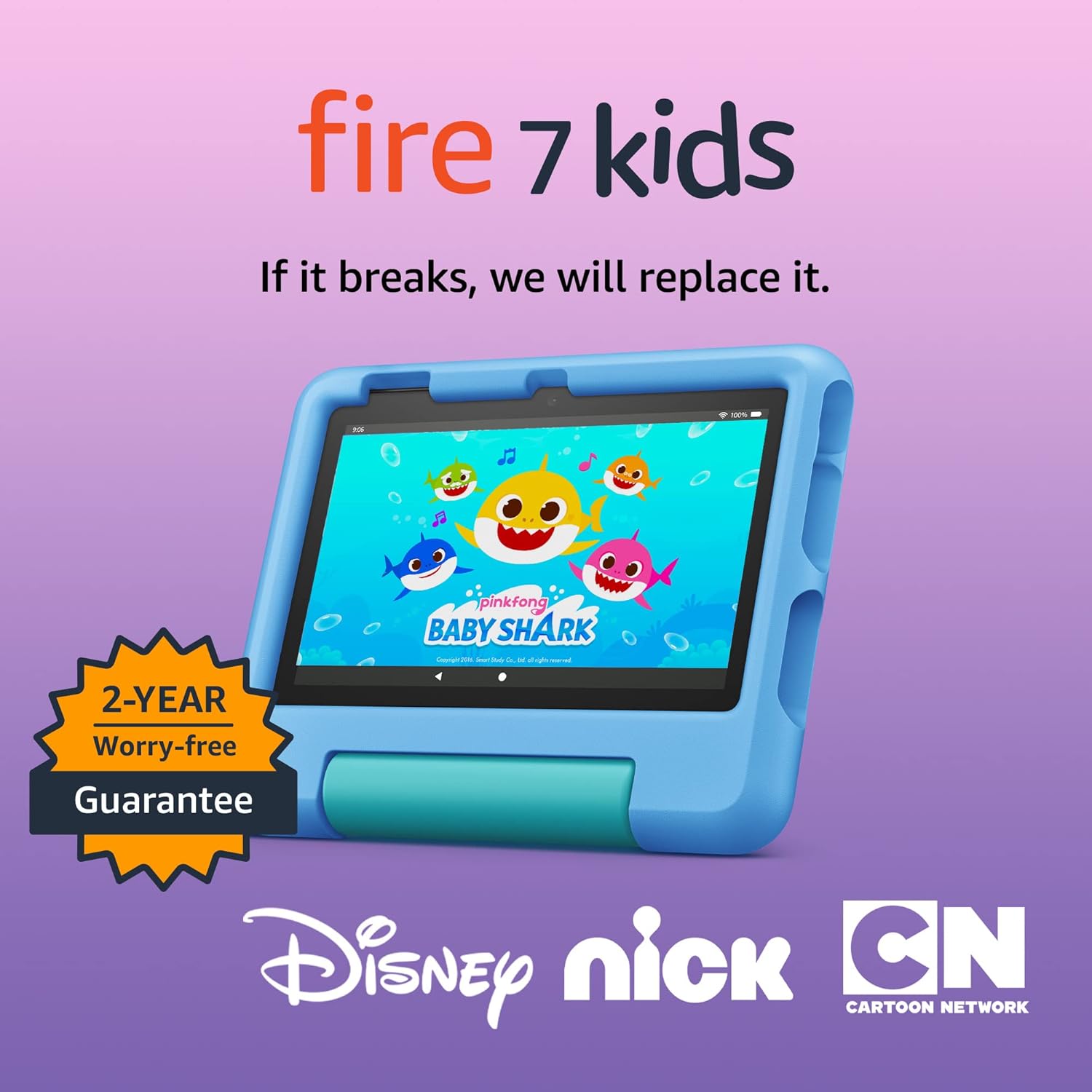
Amazon Fire 7 Kids tablet
Amazon Fire 7 Kids tablet, ages 3-7. Top-selling 7\" kids tablet on Amazon. Includes ad-free and exclusive content, easy parental controls, 10-hr battery, 16 GB, Blue
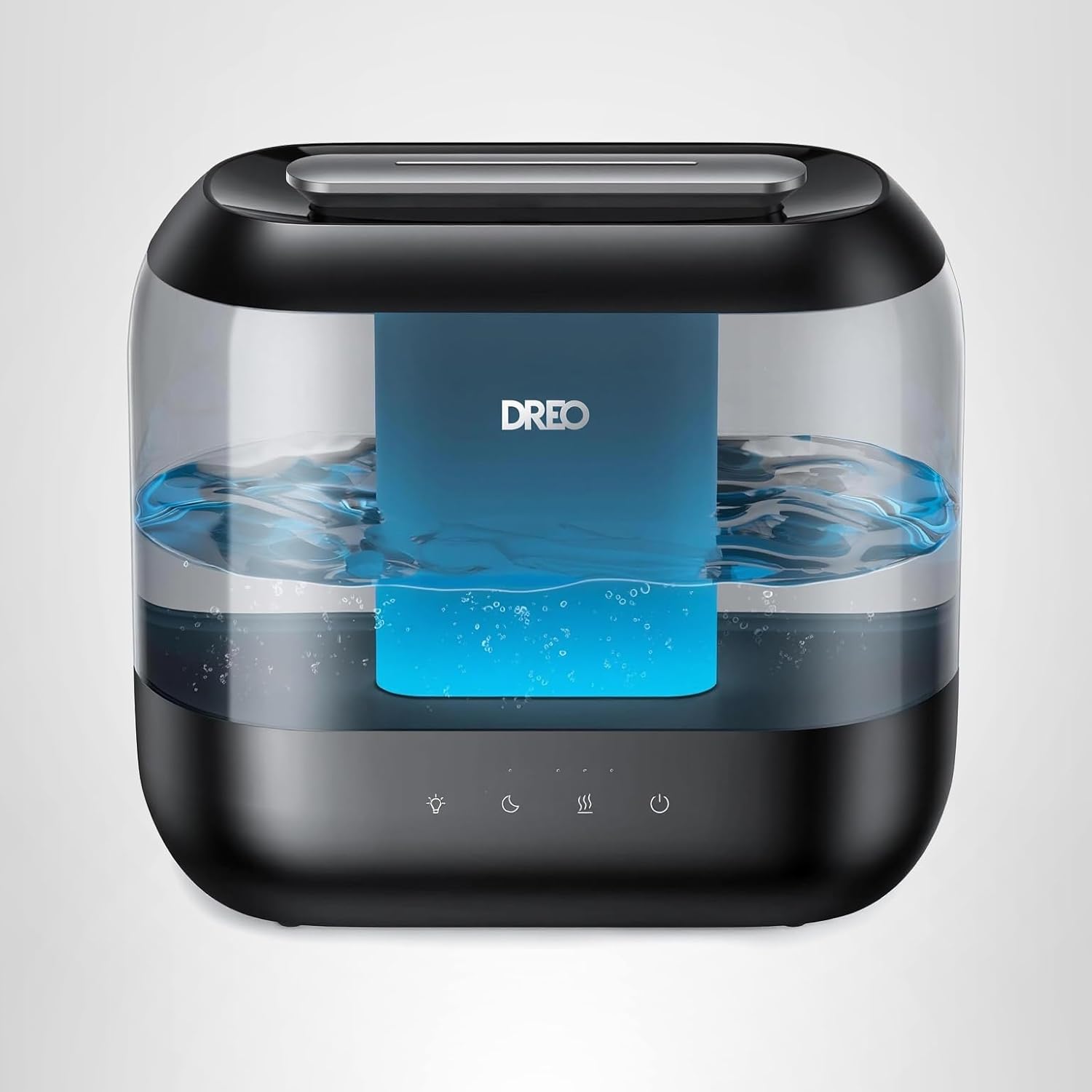
Dreo Humidifiers for Bedroom
Dreo Humidifiers for Bedroom, 4L Top Fill for Large Room, 36H Runtime, 28 dB Quiet Supersized Cool Mist Air Humidifier for Baby Nursery, Plants, Indoor, Night Light, Easy to Clean & Fill, Black

Logitech G
Logitech G PRO X SUPERLIGHT 2 Wireless Gaming Mouse

NUBWO U3 Gaming Headset
NUBWO U3 Gaming Headset with Microphone, Safe Volume Limited, Kids Headphones for Switch, Super Lightweight, Rich Sound, 3.5mm Jack for NS, PS4, PS5, Xbox, Tablet, iPad Computer, Red

Razer
Razer Basilisk V3 Pro 35K Wireless Gaming Mouse: HyperScroll Tilt Wheel - 35K DPI Optical Sensor Gen 2-13 Customizable Controls - Chroma RGB - Optical Switches Gen 3 - Up to 140 Hr Battery - Black

Canon PG-275
Canon PG-275 / CL-276 Genuine Ink Value Pack (2 Cartridges), Compatible with TS3520/3522/4722/3720/3722, TR4720